
Purpose Statement
Our international friends come to ESL classes primarily to improve their English, so we want to try to offer quality ESL training to them. But providing quality ESL value is difficult with a volunteer teaching team. Your purpose is to help us provide that quality ESL without discouraging our volunteers. At the school level, you own adding English learning value.
ESL School Teaching Coach
https://team.internationallink.org/opportunity/esl-school-teaching-coach/
Role Details
The following information is not public, either because it is too detailed for the website role overview or because it has sensitive information not fit for a public webpage.
Instructions / Suggested Best Practices for Recurring Tasks
-
make lesson plans a priority. it’s a way to get visibility into classes without being there.
-
have a veteran teacher give feedback on a new teacher’s lesson plan like Carol Woodford did during GA/NAMB hybrid training
-
Note course resources in MyEnglishLab (e.g. https://myenglishlab.pearson-intl.com/courses/content/1662655#!/2166684)
-
Schedule being in one of the classes each week. Ask Teachers if they would prefer you only to watch or help in some way (e.g. do a game or drill or even more). Make sure to schedule this (don’t just show up) as it can unnerve some Teachers.
-
ask teachers to donate lesson plans for possible inclusion in lesson plan library
-
ask teachers their favorite activities and if willing to explain it (over zoom?) so that we could record it
-
Have teachers visit each others classrooms
-
Give out minimal pairs exercises
-
Offer to teachers to do devo or game
-
Learn from veteran teachers their favorite teaching techniques to make a library
-
Try to get ESL teacher curriculum from baptists (split online / in person)
Current One-Time Tasks
-
Helping students with pronunciation.
-
Good morning y’all!
-
Sorry that I didn’t have John (Nurullah) & Mila on your attendance print out. I think they were at ESL last week… is that right?Also, sorry about ambushing you Frank when Mila was talking with me. She was pressing me to be put in level 4 (which her comprehension/reading assessment would align with), but her speaking assessment score does not justify it. I thought it would be helpful to loop you into the conversation so you could help her find some ways to strengthen her speaking. But then I felt like I had blindsided you. Sorry about that. She’s not alone, I had a similar conversation with another student who felt they should be in a higher level but their speaking does not justify it even though their reading comprehension does.
-
Warm regards,
-
Jonathan Stamberg
-
This seems to be a more crucial area for most of our students. I would appreciate any materials that would allow for more vocabulary and pronunciation excercises. Thank you, Janice
-
Ok, thanks so much for your feedback Janice. Will work on this…
-
-
-
-
Easter is coming.
-
Dear Teachers,
-
The year is quickly passing now that Spring is here. At least it always seems to me that it flies by once the weather turns more pleasant. There are a few things for you to be aware of as we wind down the year. First, remember that we DO have class this Thursday. We DO NOT have class the next week due to Masters. Please make sure you contact your students to remind them there is class this week but not next week. I find it helpful to send a reminder to come to class this week. And then send another reminder next week that there is NOT class. Then it doesn’t hurt to remind them the following week that class is back in session. You can actually write all three of these emails at once and schedule them to be sent out on different days. I frequently forget about this handy feature of email.
-
April is not just busy because of Masters. BTW this week you could include a culture lesson on what it is and what to expect during Masters. Probably a lot of our students have never been her for the full-fledged circus. Lately there have been a lot of other things to do in town during Masters – things that don’t require a badge or even a ticket. You might look online for a list of some of these fun, family-friendly (or not) events.
-
On the heels of Masters is our celebration of Palm Sunday and Easter. Obviously this is both a culture lesson and an opportunity to share the gospel. Palm Sunday is April 10, then class resumes on April 14 and Easter is April 17. So factor this all into your lesson planning. Another thing to be aware of is that Ramadan starts April 3 – in case you have any Muslim students.
-
There are lots of resources online as you plan for Easter. The PCA’s Mission to North America is a great place to start. You can find their resources here. You can also find more by doing an internet search like: “adult ESL lesson plans for Easter” or “Christian adult ESL lesson plans for Easter.” (Or some variation of that phrase.) Also, I love the videos that the Bible Project makes. They have topical videos as well as a series on each book of the Bible. You can check out their YouTube channel here. Their Luke series has 5 videos. The 5th one is on the Resurrection of Jesus. A wonderful detail to be aware of is that their videos are often translated in multiple languages. You can view the language channels they offer here. If your students are interested, they can watch all videos available in their own language. (Note that all videos have not yet been translated into all languages.)
-
And while I’m talking about videos, remember that YouTube offers a lot of really great video lesson content from some talented ESL teachers. I often search for YouTube videos to explain the grammar concepts I’m teaching each week. You’ll just need to preview them to find one that is at an appropriate level and does a good job of explaining what you want to cover.
-
And finally, I believe the last day of class for this year is May 12. Jonathan, tell us if I’m mistaken. Thanks so much for all you do to befriend your students and your diligence to prepare for class each week. I know it has sometimes been discouraging these last few years but let’s press on. If you have any questions, please let me know.
-
FYI, I will not be in class this week. I’m going to visit my daughter and son-in-law. Have a wonderful week and an enjoyable Masters week.
-
Blessings,
-
Beth
-
-
Last English class for the school year
-
Dear Friends, https://drive.google.com/file/d/15zYLkMKV1vbG_dD_aNQFJvoyi4TccI-B/view?usp=drive_link
-
I’m so glad you all have participated in our English class this year. It’s been a year to remember for us all.
-
I wanted you to know that this Thursday is our last day of classes for this school year. We do not have regular classes during the Summer. Our classes will start again in September. We’ll send you an email reminder in August so you can register for classes in September.
-
There are lots of ways you can continue to practice your English during the Summer. If you haven’t requested a conversation partner, please go to our website and register for one. We have American volunteers who will help you practice everyday conversation. This is what we usually call “small talk.”
-
I recommend that you listen to English radio stations and English music (Spotify, Napster, Amazon). Watch American TV and movies. (I love British and Australian movies on Netflix and Amazon. However, the accents are very different and even their vocabulary is different. It will not help you practice your listening skills needed to live in America.) There are lots of interesting, entertaining and educational videos on YouTube, also. And you can slow the playback to help you understand the words.
-
There is a YouTube channel called “Learn English with TV Shows.” These videos use American TV shows and movies – or even music – to talk about American culture and vocabulary. There are plenty of YouTube channels that teach English grammar. (Rachel’s English, English Class 101 and Jennifer ESL are three good ones that I like.) You might also find channels for hobbies that you like. You can learn cooking, knitting, gardening or how to fix your car. I know you already use YouTube. Just watch YouTube in English.
-
You can also listen to or read English books for free at our public libraries. The local public libraries are open again, although they may have limited hours of operation. All you need to borrow books is a library card. You can get a free library card at any library location. You need to show a photo ID with a GA address or a photo ID and proof that you live in GA (such as a bill with your name and local address on it). Go online to find a library near your house. You can search “public library near me.” SC has a different library system but the same principles apply.
-
International Link will host group activities during the Summer. Look for emails and posts on Facebook and Instagram for information about these events. We’re so grateful to have the opportunity to serve you. We look forward to seeing you in September too. -Beth Gore <>
-
-
Live teaching video coverage for library building objectives.
-
Hi Rita, Liz, Mary Lynn, StPaul,
-
Hope you’re having a great day. On my radar for a while has been improving the training and support that we give our newer teachers and potential teachers. I’m sensing that, for those who have not taught before, it can be intimidating and mysterious to think about what goes on in a classroom, how to structure the time, how to respond to the unexpected, etc.
-
Since you’re a veteran teacher, and one whose teaching/ministry DNA I would love to have be a part of new teachers, here’s my ask: may I video some of your teaching? Even 5 minutes one time would be great. More times would be wonderful. My objective is to build a library of short examples of specific teaching techniques/ideas/etc, at various levels. Those examples could be a single exercise from the book, or even a particular activity outside of the book that you enjoy or find helpful. That way our new teachers could have something to look at 1) when they’re considering taking the plunge & 2) when they are trying to develop their own skills. I’m also considering revamping our teacher training and possibly incorporating some of these videos in there. You could think of it as a way you can help disciple the next generation of ESL teachers.
-
I am guessing that one thought may be the impact on your students. We could arrange the recording so it is either limited to you or to you and those students who don’t mind being recorded.
-
If you’re not sure, would you at least be willing to pray about it? -Jonathan
-
Hi Jonathan,
-
Yes, that would be fine if you want to record me. I have some thought about it, though.
-
I dont think the students would be acting naturally while recording. Our goal is to get the students to do most of the talking, and I think they may very well shut down if they know they’re being recorded. (We can try it if you want ).
-
If anyone wants to come in and observe, that’s good, too. We’ve had 2 or 3 visitors come in for part of the class and the students have acted naturally. I wonder if they could record without being noticed. I dont know.
-
The only other thing I could think of is to have the students sign a paper (or just be asked) if they mind being videoed for teaching purposes and then videoing them unawares. I dont know how we would do that.
-
Whatever you want to try is OK with me, Jonathan.
-
-
**********************************************************************
-
Good afternoon!
-
Thank you for your kindness. Yes, I am available for your to video. My suggestion would be to not put the students in the video at all. They won’t understand what is going on.
-
Here are some thoughts about teaching ESL.
-
** Class should be fun.
-
** Lower classes need lots of repetition. It’s key to find ways to repeat words, etc. that are not boring. (Levels beginner, one, two and three).
-
** It is key that students do most of the talking and NOT the teacher. Definitely in Levels 4 and 5, prepare classes that have lots of involvement from the students.
-
** When a student makes a mistake it is best not to correct, but rather to repeat and review pronunciation of particular mistakes for the whole class.
-
** I think the lower class levels and the highest class level are the most difficult to teach. The lowest class(es) need the most repetition. Drilling particular problems as a group is important. The highest level (4 and 5) have learned some bad habits — how to pronounce certain words, adding -ed to a verb, mispronunciations of words in a sentence or alone. So that group of students need lots of repetition.
-
** Classes should be fun and interactive. I have crawled under a table to teach «under » or on (get on the table).
-
** Be sure and praise your students, especially when they have learned something new or are almost correct.
-
** Pray! Pray for your students by name and out of class. Pray!!!’
-
Thanks!
-
Kept by His grace,
-
*************************************************************************
-
It’s a good idea. I’ll pray about what that would look like and an appropriate lesson. -Mary Lynn <>
*************************************************************************
-
Good day, Jonathan,
-
Yes, I’m interested in your proposal about assisting you with teacher training. Also, I’d like to change the subject to say that I reassessed Bilel Merouane on Tuesday afternoon. He assessed at level 4 with a score of 46. I shared the results with him today, and he would like to move to the Level 3 class. I’ll send you a copy test results tomorrow, as I’m on my desktop computer, and I used my laptop for the assessment.
-
Kind regards,
*************************************************************************
Current Questions/Challenges
-
Teaching language thoughts from Janie
-
Community based language learning
-
Dif curriculum
-
Examples of past tasks
-
Past recurring tasks or completed one-time tasks
Ideas
-
Have teachers visit each other’s classes (scheduled ahead of time) to help them get ideas from each other
-
ESL game ideas…
-
have them put selves in alphabetical order
-
corners based on preferences (and sentence to explain why)
-
fly swatter
-
Nancy has list of games
-
-
-
Ideas for February ESes
-
Dear Teachers,
-
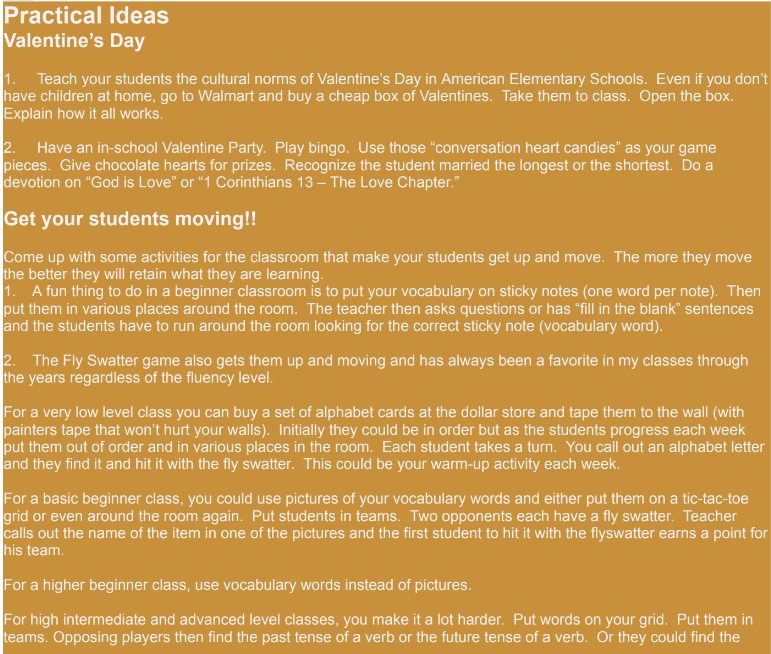
Today is the beginning of February and you can have a lot of fun with Valentine’s Day. There are two ESL classes beforem Valentine’s Day. Naturally, you can have an American culture lesson and talk about the history of Valentine’s and how we celebrate today. Nancy Booher (MNA ESL Director) has some great ideas in her monthly newsletter. I’ve pasted them below. She also had a great reminder to keep it up with your short devotions. A lot of people have to hear the gospel dozens and dozens of times before they respond.
-
Blessings, -Beth
-
-
-
Since we’re still not having group break time, this is a wonderful opportunity to treat your students to an in-class break. It can be very simple. It’s fun to introduce internationals to your favorite prepackaged American snacks. (Think Little Debbies and Valentine’s candy.) Don’t forget drinks or at least cups for water.
-
References
-
M01_Future_TP4_47695.pdf (team projects worksheet)
-
M01_Future_PA4_47695.pdf (persistence activities worksheet)
-
M01_FUT_ACBT_04_7695_U01.pdf(Activity Master worksheet)